
TIME - Koko Ni Aru Kioku
The Sakuradai House
2026
A Gift to The Architect A 2026
I Hear a Voice Calling, “Awake”
For Keiko Miyamori’s solo exhibition, TIME — Memories Here
By Nozomu Hiraoka
I Hear a Voice Calling, “Awake”
For Keiko Miyamori’s solo exhibition, TIME — Memories Here
By Nozomu Hiraoka
September 14. Holding my rain-or-shine umbrella against sunlight I had not seen in some time, I turn off the street in front of Sakuradai Station. In a corner of the residential neighborhood into which I seem to have wandered, there is a garden like the one at Morikazu Kumagai’s home, where he is said to have watched ants.[1] Rather than a photographic positive of human aesthetics—Monet’s garden, for example[2]—it holds the unforced honesty of a negative: of refraining from intervening more than necessary. “Here it is.” The certainty courses through me like a bee that has scented a spring of nectar. I follow the L-shaped path toward Bontana -atelier café-, at a pace that will not startle an unhurried butterfly. I remember Gilles Clément’s garden, where, instead of flowers and grasses being planted along paths, “most of the paths through the garden are determined retrospectively by the gardeners, in response to the movements of the plants that grow there that year.”[3]
I withdraw the foot I have stepped inside with, embarrassed by my own lack of manners. As I take off my shoes, I sense the boundary between public and private, and the way it blurs. This place seems to have been shaped by hospitality toward visitors rather than functionality for customers. A staircase stands before me. But, following the invitation to come toward the long table, I walk farther in, and it disappears—for the moment—from my field of vision. Looking around without a point of reference, I notice a cassette tape hanging on the wall to my right and approach it like an insect drawn to light. A work gives me—or us—a reason to linger in a place. As a roadside flower sometimes brings our hurried feet, and thoughts, to a halt.
Beside the cassette tape is a drawing roughly the size of an A3 sheet. Within its border of drifting pastel pink, pale gradations of green and yellow also form planes of color. Slightly above the center, a faint rectangle, apparently a window, asserts its presence. “Perhaps it depicts this place,” I think, because to my right as I face the drawing, the loft-like tatami sitting area also has a window, beyond which the shadows of trees sway. If the wind, now growing a little stronger, were to open that window, leafy shade might come rushing in, as it does in the picture.
Yet this waking dream leaves out several crucial elements of the work. First, across the whole of this “pastel drawing,” broken black lines flicker like firelight, like waka poems brushed in a scattered arrangement. Then, at the lower right, a cassette tape has been drawn at a scale of one to one. I immediately recognize the former as pieces of tree rubbing pasted onto the surface: I have seen Miyamori’s work before.[4] She places thin, fibrous washi paper against bark, rubs it with charcoal, and takes an impression. In particular, her ongoing project of rubbings given sequential numbers based on their dates, whose documentary photographs she posts on social media with daily notes, is titled TIME.[5] It is easy to associate it with the works of On Kawara. The postcards of I Got Up, for example, sent daily as though checking a circuit for continuity, testing the international postal system. Or the terse telegrams bearing the words I Am Still Alive.[6]
Does that “time difference” unsettle us because we are too connected? Conversely, Miyamori’s practice and our own days inevitably run alongside each other on the platform called Instagram. If On Kawara’s life was something like a B-side for the recipients of his works, our everyday lives are already melting into one another.
Might this mingling of times apply equally to the street trees from which Miyamori takes her daily rubbings? For “them,” who do not “make their home in uncultivated fields, beside a spring known only to little birds,”[7] no happiness such as this can be hoped for:
“They take long to die, and they protect the standing dead until they fall to dust.”[8]
They are cut down at once. In the miniature titled “A Family of Trees,” Renard portrays someone who comes to feel that “they should be my real family”[9] and falls into step with the trees’ time. Street trees, by contrast, are entangled in human time. Humans themselves are no different. Perhaps a tree rubbing is the very act of solace that occurs when Miyamori, one human caught in the bonds humans have made for themselves, encounters and touches one of the trees caught up in them too.
“Yaeko entrusts her body to us, and we continue to touch it. In this way we have passed time together. Now even that is coming to an end. That body will soon become ash and return to the earth. When we think that we will never touch it again, Yaeko’s body takes on a sacredness and an awe. Everyone vies to care for her. They want to touch that body.”[10]
Touching—sawaru, fureru—is both solace and a method, a way of the hand, for remembering always. It is familiar to me too because, as a small child, when I realized that my mother was “always ten years older than my friends’ mothers,” I spent a while constantly holding her hand or throwing my arms around her. Driven by the childish calculation that “I have ten fewer years to be with her than everyone else,” my hands have since hardened with calluses, and my mother’s skin has grown more wrinkled.
“Here is a book of photographs consisting entirely of parts of the bodies of women born in 1947: Miyako Ishiuchi’s 1·9·4·7 (IPC, 1990). […] If their twisted toes, the soles of their feet covered in scabs, their nails with chipped polish, and the backs of their hands, whose exceedingly thin skin is traversed by countless fine lines, are none other than their ‘faces’—if, in other words, they are the women themselves—then we cannot simply stare at them. That is the kind of photobook this is. Hands and feet are the parts most distant from the face, that site of personhood. I think Ishiuchi’s photobook was an attempt to restore a ‘face’ to those parts.”[11]
Conversely, tree rubbings too must be an attempt to “restore a ‘face’” to a tree as our “neighbor,” bringing its “sediment of time”[12] to the fore. Returning my attention to the work before me, I see that the cassette tape wears a piece of tree rubbing as closely as skin with a slight ripple of gooseflesh; its wrinkles have also been drawn into the depiction at the lower right. The rendering is so precise that it is difficult to tell the two apart without looking closely. It preserves Miyamori’s powers of observation and, no less, the time she has spent. Yet:
“Unlike ‘being’ understood as a ‘thing,’ objectively theorized as an object of ‘seeing,’ the ‘fact of being,’ which never loses its character as an ‘event,’ can be known only by ‘listening’ to it as a silent voice. Whereas seeing something becomes possible only at a certain distance, ‘listening’—whether to a living voice or to a voice within the heart—occurs close to us ourselves.”[13]
Perhaps it would be truer to say that, rather than looking, she listens intently, placing herself “on the side of the subject, or in the ‘between’ of object and subject.”[14] We viewers, too, trace our eyes over the “skin” of cassette tapes bearing titles such as these, trying to hear a “silent voice”:
Cassette tape #260707 Time between A and G Cassette tape #260706 Time between A and S Cassette tape #260709 Time between A and H[15]
The “A” joined to someone else by “between A and …” refers to the architect Tsutomu Abe, who designed this place, Bontana, the “House in Sakuradai.” The tape recorder and Miyamori simply recorded/remembered the voices of speakers—G, S, H …—who had ties to him. We cannot actually listen to these recordings, which will be returned to the speakers after the exhibition for them to keep. But might they preserve the space of Bontana, where they were recorded—and of the buildings associated with Abe—in the form of faint incidental sounds and reverberations? And the recorded voice might suddenly be heard doubled: by the voice of “him,”[16] the ginkgo standing before Bontana’s entrance, whose skin wraps the cassette tapes.
“People do not acquire language so much as enter into it, or come to speak because they are passively enveloped in it. But language sounds together with all kinds of sounds that are not language, and just as the ear is a sound-gathering instrument with an earlobe, I felt that a house too was
something like an organ that gathers sounds from outside and lets sounds within it resonate. Without some occasion to prompt it, a voice would not be picked out from the various sounds, nor would that voice become words and acquire meaning. It was not that the house intervened in this process: I felt that the house’s gathering and resonating of sounds was itself the same process by which a voice is picked out from sound and becomes words.”[17]
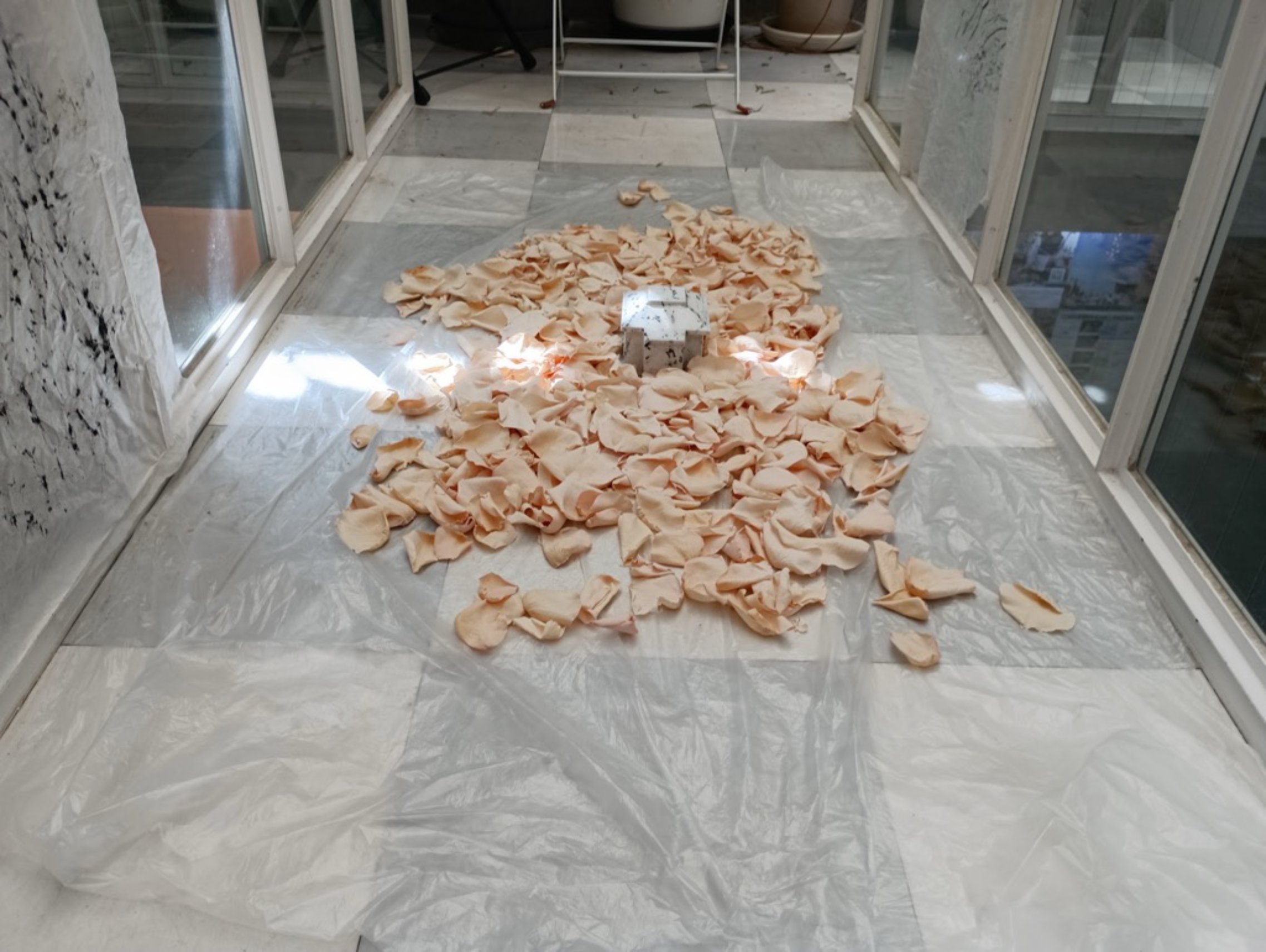
A house as “an organ that gathers sounds from outside and lets sounds within it resonate,” and humans passing between its interior and exterior. Does that image not suggest an analogy with the relationship between a cassette deck and a tape? I slowly climb the staircase, now a promenade where “tree rubbings of the ginkgo, fragrant olive, maple, dogwood, and other trees growing in Bontana’s garden are displayed.”[18] As though warming my back in the sunlight from the skylight. After spending some time with the cassette tape—and drawing and documentary photograph—on the wall at the end, I turn left. Even in the moment of taking a single step, impressions rush upon me all at once: the warm air rising from downstairs, and the heat more than sufficient to warm the pure white sunshade, together making this glazed space a greenhouse. At the same time, beyond the passage like a chalk-white bridge, like the short crossbar of an H laid on its side, there is a drawing of a house somewhere like here, yet not here.[19] What lends it the air of “the farther shore” is the rose petals, drained of color like snow, that have fallen and accumulated on the floor. In the middle of their “lake” stands a small house, again clothed in tree rubbings, resembling the drawing on that “farther shore.” Miyamori’s voice and those of the café’s proprietors rise from below. Their figures are visible through the glass walls. Two plates of appetizers wait in the kitchen, equally exposed to view … Amid all this, what “calls me to a halt” is the light. Sunlight pierces that house, with its air of a burial offering,[20] straight through from the side. Like a thermometer slowly cooling, its line moves along the narrow passage some five centimeters toward “this shore” in the course of ten minutes. As I crouch, the lingering scent of roses, warm and faintly flesh-like, tickles my nose, already beginning to suffer from the autumn grasses.
“I wonder how far back dogs and cats can follow a scent that has been left behind. So long as they can follow that scent, perhaps a cat arriving later feels, in a way different from how humans understand it, that the cat that left it, that once lived there, continues to exist. In the same way, perhaps for our cats the presence of my aunt, who is no longer in this world, has not entirely disappeared.”[21]
He favored FriXion ballpoint pens and Gekkoso sketchbooks,[22] and was devoted to cooking.[23] Suddenly I feel I hear the voice of that “Mr. A” from the cassette deck beyond the roses[24]—wrapped, of course, in tree rubbings. Saying, “Society is the relationship between me and other people.”[25]
〈End〉
Photograph by the author. [26]
Notes
The title alludes to J. S. Bach’s Cantata No. 140, Wachet auf, ruft uns die Stimme.
All URLs cited in the original essay were last accessed by its author on September 29, 2026.
[1] As Kumagai himself said: “When I go out sketching, I look forward to seeing unusual trees, grasses, and flowers. If I find something rare in a field or in the mountains, I bring back just one plant and transplant it in the garden. Sometimes it takes root and sometimes it does not; just when I think it has failed, it suddenly flowers after two or three years. That too is a pleasure.”* Judging from photographs, this space, “less than fifty tsubo even including the back area and the alley,”** looks less like a garden than a small woodland through which an animal trail barely passes.
* Morikazu Kumagai, Heta mo e no uchi (roughly, Even Clumsiness Is Part of Painting), Heibonsha Library, p. 155.
** Takeshi Fujimori, Dokuraku: Kumagai Morikazu no sekai (Solitary Enjoyment: The World of Morikazu Kumagai), Sekai Bunka Publishing, p. 68; see also pp. 67–96.
[2] See Sanjiro Minamikawa, Inshōha no Mone “Hana no niwa, mizu no niwa” e: Jivuerunī suiren ni miserarete (To Impressionist Monet’s “Flower Garden and Water Garden”: Enchanted by the Water Lilies of Giverny), Sekai Bunka Publishing. The photographs and schematic plan (p. 20), and the statement that he employed six gardeners (p. 27), give a sense of Monet’s meticulousness as a gardener and the scale of his gardens.
[3] Tsunehiro Uno, Niwa no hanashi (On Gardens), Kodansha, p. 68.
[4] See Nozomu Hiraoka, “Taisetsu ni shimatte oita binsen ni moji ga umarete yuku no o miteta: Aru kojintaku de, hissori to okonawarete ita tenji ni yosete” (“I Watched Words Come into Being on Writing Paper Carefully Put Away: On an Exhibition Quietly Held in a Private Home”). https://note.com/nozomu_h/n/nba351d68df75
[5] An ongoing art project begun on October 11, 2021. It was preceded by I am Still in New York, undertaken from April 20 to August 22, 2020, and I am Still in Japan, from January 14 to April 3, 2021. These titles presumably refer to Kawara’s I Am Still Alive, discussed below. See https://www.keikomiyamori.com/i-am-still-in-new-york-jp.
[6] See Nemuri ten: Āto to ikiru koto—Goya, Rūbensu kara Shiota Chiharu made (The Sleep Exhibition: Art and Living—from Goya and Rubens to Chiharu Shiota), the Independent Administrative Institution National Museum of Art, pp. 139–151.
[7], [8], [9] Jules Renard, Hakubutsushi (French original: Histoires naturelles), translated into Japanese by Kunio Kishida, Shincho Bunko, pp. 219–220. The story is “Une famille d’arbres” (“A Family of Trees”).
[10] Asa Ito, Te no rinri (Ethics of Hands), Kodansha Sensho Métier, p. 137. See also Takao Murase, Akirameru yūki: Oi to shi ni sou kaigo (The Courage to Let Go: Care Alongside Aging and Death), Bricolage, pp. 10–11.
[11], [12] Kiyokazu Washida, Hito wa naze fuku o kiru no ka (Why Do People Wear Clothes?), Chikuma Bunko, pp. 158–160.
[13], [14] Bin Kimura, Jikan to jiko (Time and Self), Chuko Shinsho, pp. 15–16. Quotation marks in the Japanese excerpt indicate emphasis dots in the original.
[15] Belatedly, I should mention that, as of September 25, 2026, nine sets of these cassette-tape works, their paired drawings—for example, Drawing #260707 Time between A and G—and the corresponding documentary photographs of the tree rubbings were displayed in various parts of Bontana.
[16] I remember the proprietor saying something like, “It drops a lot of leaves—we even considered cutting it down at one point—but luckily it does not bear ginkgo nuts, so it does not smell.” If my memory is correct, it would appear to be a male tree.
[17] Kazushi Hosaka, Kanbaseishon pīsu (Conversation Piece), Kawade Bunko, p. 414.
[18] From the display text “About the Works on View,” posted partway through the exhibition.
[19] Later, Miyamori told me downstairs that this was a lithograph by Abe himself depicting his representative work, House with a Center. This information was subsequently added to “About the Works on View.”
An image of the lithograph also appears in Tsutomu Abe and Mitsumasa Fujitsuka’s Chūshin no aru ie: Kenchikuka Abe Tsutomu jitei no gojūnen (House with a Center: Fifty Years of Architect Tsutomu Abe’s Own Residence), Gakugei Shuppansha, pp. 4–5. The book also reproduces a frottage of an exterior wall* (p. 106); this technique, also used in the tree rubbings, gives a particularly vivid visual sense of architectural texture. Bontana, the “House in Sakuradai,” is also mentioned (p. 138).
* I could not locate a credit, but might this be one of Tomoharu Makabe’s Urban Frottage works? See Shinkenchiku Jutakutokushu, August 2017 special issue, The Japanese House: Architecture and Life after 1945, Shinkenchiku-sha, p. 59.
[20] Like, for example, a “house-shaped haniwa,” said to date from the Kofun period. See https://collection.kyuhaku.jp/advanced/41825.html.
[21] Conversation Piece, p. 10; see also note 17.
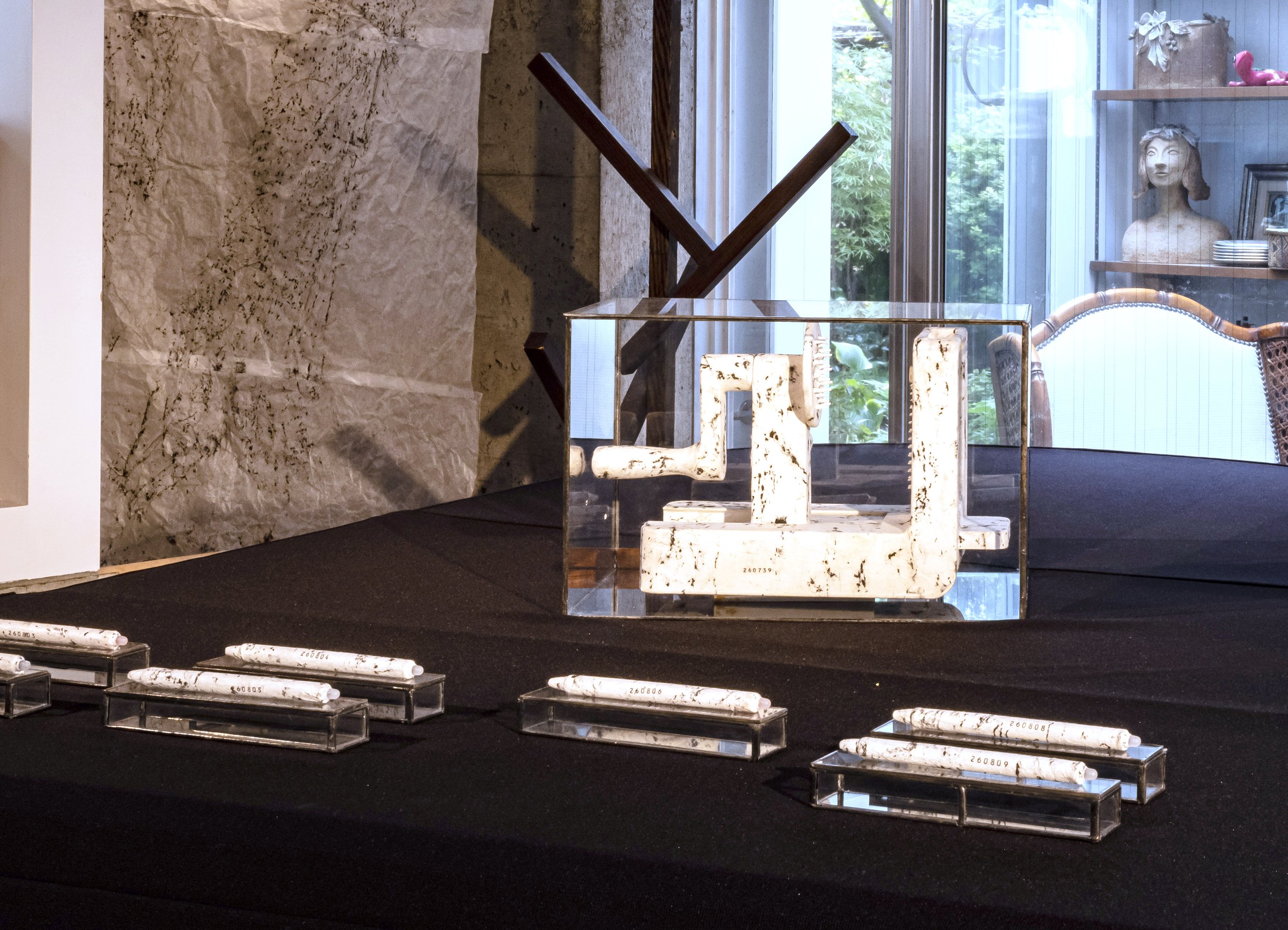
[22] FriXion ballpoint pens and sketchbooks, both adorned with tree rubbings and titled TIME – A’s desk. Eight pens were displayed on the black-covered grand piano in the first-floor café space, and six sketchbooks in a cabinet near the entrance.
[23] A’s kitchen #260739, an OXO spiralizer—a kitchen tool that cuts vegetables into noodles or spirals—covered in tree rubbings, was displayed on the grand piano alongside the FriXion pens.
Abe’s love of cooking can also be seen in publications such as NHK Shumi Doki! MOOK: Hito to kurashi to, daidokoro—16 no katachi (People, Life, and Kitchens: Sixteen Forms), NHK Publishing, pp. 102–109.
[24] The second-floor installation, including this cassette deck, which was used to make the present cassette-tape series, was titled A / A Gift to Architect A.
[25] An anecdote in House with a Center: Fifty Years of Architect Tsutomu Abe’s Own Residence, p. 131. A social-studies teacher at the private Musashi Junior High School is said to have spent a whole term asking the pupils, among them the young Abe, “What is society?” In the final lesson of the term, he wrote this sentence in large letters on the blackboard.
[26] Photograph taken on September 14, 2026, at 1:34 p.m. Following Miyamori’s example, might it be called “Photograph #260914 Time between A and H”? At that time, the cassette deck was not yet on display.